
Day trip from Madrid Valencia
Spain's third-largest city, on the Mediterranean, with a Gothic old town and the City of Arts and Sciences, about 1 hour 54 minutes from Madrid by AVE.
Is Valencia worth a day trip from Madrid?
Possible in a day. Better with a night.
Possible in a day, better with a night. The AVE takes 1 hour 54 minutes to 2 hours 05 and Renfe lists € 81.30 each way, or € 59 on the three daily Avlo trains. That is € 118 to € 163 on trains alone. The bigger problem is size. The old town, with the cathedral at € 12, fills a day by itself, and the City of Arts and Sciences sits well outside it. You will not do both and the beach. On Sundays the cathedral only opens at 14:00. No coach tour from Madrid covers it.
The decision sheet
- Travel time
- 1 h 54most trains take 2 h to 2 h 05 · one way · Renfe timetables and prices
- Transport
- AVE high-speed train
- Self-guided cost
- € 130–174.60Train return at Renfe's listed fares (Avlo € 59 or AVE € 81.30 each way) + cathedral ticket with audio guide (€ 12) · Renfe timetables and prices
- Tour price
- –
- Time needed
- 7–10 hDaytripo editorial
- Closed days
- None weekly. Sundays open from 14:00 only (Oct-Jun); shut 1 and 6 Jan, 19 Mar, Palm Sunday, Good Friday, 9 Oct, 8 and 25 Dec
- Best time
- Mar-Jun and Sep-Nov; stay a night to add the City of Arts and SciencesDaytripo editorial
- Verdict
- Better to sleep thereDaytripo editorial
What to see and do in Valencia
- 01
City of Arts and Sciences
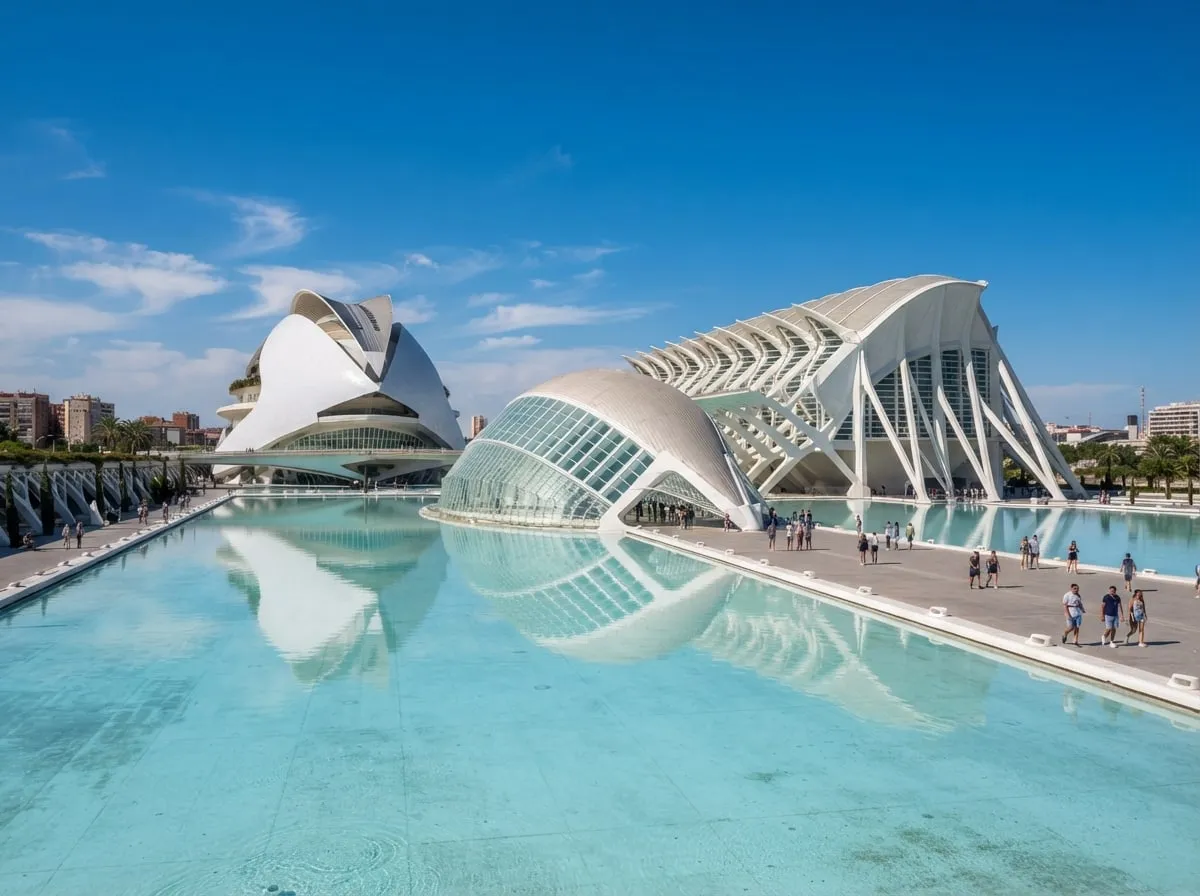
A complex of white concrete buildings set in pools at the end of the old riverbed, 3 km from the centre. Walking around it is free. The Oceanogràfic aquarium alone takes three hours.
- 02
Silk Exchange
La Lonja, a 15th-century Gothic trading hall with twisted columns 17 m high, is a World Heritage site. Open daily, Sundays until 14:00 only, when entry is free. Allow 30 minutes.
- 03
Central Market
An iron, glass and tile market hall from 1928 with close to 300 stalls of fruit, fish and cured meat, opposite the Lonja. Open Monday to Saturday, 07:30 to 15:00, and shut on Sundays.
- 04
Cathedral and the Miguelete
The cathedral mixes Romanesque, Gothic and Baroque doors and shows a chalice it presents as the Holy Grail. The bell tower is 207 spiral steps. Allow an hour for both.
- 05
Turia Gardens
A 9 km park in the dry bed of the diverted river, linking the old town to the City of Arts and Sciences. Walk it in 45 minutes or rent a bike.
How to spend the day
If you do it in a day, take the 07:30 AVE and arrive at 09:30. Walk into the old town and see the Central Market and the Silk Exchange first. Be at the cathedral when it opens at 10:30 and climb the Miguelete tower, € 3 extra. Lunch near Plaza de la Virgen. Spend the afternoon in the Turia gardens or at the City of Arts and Sciences, not both. Trains back leave at 17:42, 18:32 and 19:42. The last is the 21:12 Avlo.
Valencia in summer and in winter
Summer
June to AugustFrom June to August highs are around 30 °C, lower than Madrid's, but the humidity makes it feel heavier. This is the one trip with a beach: Malvarrosa is 20 minutes from the centre by bus or tram. See the old town before 12:00, eat paella by the sea and swim after. The Oceanogràfic keeps its longest hours and longest queues.
Winter
December to FebruaryFrom December to February Valencia is the warm option, with highs of 16 to 17 °C and plenty of sun, about 6 °C above Madrid. The main sights keep their normal days and it is orange season. The sea is too cold for swimming and it gets dark around 18:00. A good winter day out if you accept the long ride.
How crowded it gets
Busy- Busiest
- Fallas, 1-19 March; Easter week; Jul-Aug at the Oceanogràfic
- Quietest
- Nov-Feb except Christmas; weekday mornings
The old town absorbs visitors well outside Fallas. The Oceanogràfic is the bottleneck: buy a timed ticket ahead and enter at opening. The Central Market is jammed with tour groups from 11:00 to 13:00, so go at 09:30.
How do you get to Valencia from Madrid?
- Travel time
- 1 h 54 to 2 h 05
- Frequency
- 15 Renfe trains on weekdays, 11 on Saturdays
- Cost
- € 59-81.30 each way
- Departs from
- Madrid Chamartín-Clara Campoamor (check your ticket)
Renfe lists AVE at € 81.30 and Avlo at € 59, leaving Madrid at 06:30, 12:30 and 18:30. Fares in the booking system move with demand. Most trains use Chamartín, but a few Renfe AVE services still use Puerta de Atocha. You arrive at Valencia Joaquín Sorolla.

Practical: clothes, food and money
What to wear
Light clothes for most of the year and a mid-weight jacket in winter. Comfortable shoes, since the old town and the City of Arts are far apart. Swimwear, a towel and sunscreen from June to September.
What to eat
Paella valenciana, with chicken, rabbit and flat green beans, is a lunch dish cooked for two or more, so allow 30 minutes for it. Eat it by the beach or in the old town. Drink horchata, a cold tiger nut milk, with fartons, long sweet buns made for dipping.
What you will spend
Trains take most of the budget: € 59 each way on an Avlo, € 81.30 on the AVE. The cathedral is € 12 and the Miguelete € 3 extra. The Oceanogràfic is the one expensive ticket. The Lonja charges little, and the Turia gardens, the market and the beach are free.
How to get the most out of the day
- High-speed trains arrive at Valencia Joaquín Sorolla. The old town is a 15-minute walk north, past the tiled Estació del Nord.
- Bus 95 links the old town with the City of Arts and Sciences. On foot through the Turia gardens it takes about 45 minutes.
- During Fallas firecrackers shake Plaza del Ayuntamiento at 14:00 daily, and from 15 to 19 March streets close to traffic. The cathedral shuts on the 19th.
- Choose between the old town with the beach or the old town with the Oceanogràfic. All three do not fit between two trains.
How long do you need in Valencia?
Plan 7–10 h on site, plus 1 h 54 of travel each way from Madrid.
When is Valencia closed?
None weekly. Sundays open from 14:00 only (Oct-Jun); shut 1 and 6 Jan, 19 Mar, Palm Sunday, Good Friday, 9 Oct, 8 and 25 Dec. Best time: Mar-Jun and Sep-Nov; stay a night to add the City of Arts and Sciences.